Zum Inhalt springen

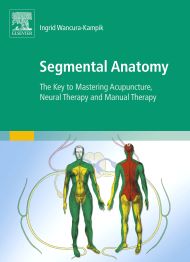
Segmental Anatomy

The Key to Mastering Acupuncture, Neural Therapy and Manual Therapy
Wancura-Kampik, Ingrid (Autor)
Erscheinungsdatum :
06/2012
Inhaltsverzeichnis
Formidably illustrated and written, the correlations between spinal nerves and segments in skin, musclar system and bones as well as the projection areas of internal organs on the body surface area are deduced from the anatomy of the nervous system. ...mehr lesen

Formidably illustrated and written, the correlations between spinal nerves and segments in skin, musclar system and bones as well as the projection areas of internal organs on the body surface area are deduced from the anatomy of the nervous system.

These correlations between spinal nerves and the periphery of the body explain how acupuncture, neural, and manual therapies take effect .
Great accessibility through:

  • Full colour images
  • Drawings that depict the correlations in detail
  • Cearly structured layout facilitating the reading of this complex subject
unverb. Preisempf.
inkl. MwSt., keine Versandkosten (D)
In den Warenkorb

Formidably illustrated and written, the correlations between spinal nerves and segments in skin, musclar system and bones as well as the projection areas of internal organs on the body surface area are deduced from the anatomy of the nervous system.

These correlations between spinal nerves and the periphery of the body explain how acupuncture, neural, and manual therapies take effect .
Great accessibility through:

  • Full colour images
  • Drawings that depict the correlations in detail
  • Cearly structured layout facilitating the reading of this complex subject
Weitere Informationen
ISBN 9780702050428
Autoren Wancura-Kampik, Ingrid (Autor)
Copyright-Jahr 2012
Auflage 1
Format Buch
Trim 196 x 270 mm
Imprint Urban & Fischer Verlag/Elsevier GmbH
Seitenzahl 384
Veröffentlichungsdatum 15 Jun 2012
Lagerstatus IN STOCK

Du magst eBooks? Dann wirst du die Elsevier eBooks lieben!

Bester eBook-Reader

Du brauchst keinen eigenen eBook-Reader. Wir nutzen den Weltmarktführer Bookshelf® von VitalSource. Einfach downloaden - Fertig

Läuft einfach überall

Nutzbar online und offline mit Laptop, Tablet oder Smartphone. Im Webbrowser jederzeit mit Internetverbindung

Synchron auf vielen Geräten

Nutze dein eBook auf mehreren Geräten gleichzeitig. Du kannst dir dein eBook auf bis zu 2 stationäre Rechner und 2 Mobilgeräte herunterladen

Coole Lern-Features

Unsere eBooks im ePub-Format bieten dir tolle interaktive Lern-Funktionen. Du kannst z.B. markieren, Notizen machen, Lernkarten erstellen, dir vorlesen lassen etc. 

So einfach geht's - eBook sofort verfügbar

1.  eBook im Elsevier Shop kaufen - du erhälst
sofort einen Code zum Einlösen

2.  Konto in VitalSource erstellen und den
Bookshelf®-Reader downloaden

3.  Code einlösen - FERTIG!

Häufig gestellte Fragen

Wir schicken dir deinen Zugangscode direkt mit der Email-Bestellbetätigung zu. Tipp: Checke deinen SPAM-Ordner, wenn du die Email nicht innerhalb von ein paar Minuten erhälst. Außerdem ist der Zugangscode auch jederzeit in deinem Account im Elsevier Webshop zu sehen.


Wir zeigen dir Schritt-für-Schritt, wie du dir den Bookshelf-Reader herunterlädst und deinen Code einlöst. Es geht ganz einfach. Hier klicken >


Dein Zugangscode ist unbegrenzt gültig. Löse deinen Zugangscode am besten gleich nach dem Kauf ein - der Code gilt nur für die akteulle Auflage deines Buches.


Der Zugang zu deinem heruntergeladenen eBook ist auf dem jeweiligen Gerät ungegrenzt gültig.


Entdecke die vielfältigen Lern-Features, die dir unsere eBooks auf dem Bookshelf®-Reader bieten! Du kannst dir z. B. Textpassagen unterschiedlich markieren, Notizen und Lernkarten anlegen, dir die Texte vorlesen lassen etc. Besonders praktisch: Du kannst deine eBooks auch offline nutzen. Mehr Info zu den Lernfunktionen findest du auf der Seite von Vitalsource.


Qualität steht bei uns an erster Stelle. Deshalb arbeiten wir dem führenden Anbieter für eBook-Reader VitalSource zusammen. VitalSource hat einen eigenen eBook-Reader Bookshelf®, den du dir ganz einfach downloaden kannst. Dieser Reader ist sehr benutzerfreundlich und kann mehr als andere Standard-Reader. Du kannst dir z. B. Textpassagen unterschiedlich markieren, Notizen und Lernkarten anlegen, dir die Texte vorlesen lassen etc. Besonders praktisch: Du kannst deine eBooks auch offline nutzen. Mehr Info findest du auf der Seite von Vitalsource.


Elsevier Deutschland bietet seine eBooks im ePub-Format an, da wir der Überzeugung sind, dass dieses Format am besten dazu geeignet ist, unsere Inhalte auf möglichst vielen Geräten ideal anzuzeigen.


Du kannst dein eBook innerhalb von 13 Tagen nach dem Kauf zurückgeben. Von der Rückgabe ausgeschlossen sind eBooks, die teilweise ausgedruckt wurden und die mehr als 15% durchgeblättert wurden.

1

Segmentation and Metamerism 1
What is a Segment? 1
The Significance of Segments 7

2

The Role of the Peripheral Spinal Nervous System in Segmentation 1
The Spinal Nerves 4
The Branches of the Spinal Nerves 15
The Three Spinal Nerve Branches As the Basis of the Threefold Longitudinal Division of the Body Surface 18
The Branches of the Spinal Nerves in Detail 32
The Dorsal Branches of the Spinal Nerves 32
The Dorsal Branches in Psychosomatic Medicine and Evolution 37
The Ventral and Lateral Spinal Nerve Branches and Plexuses 41
Plexus Formation from the Point of View of Segmental Anatomy 42
The Individual Plexuses 47
The Pre- and Postaxial Lines, Basis of the Meridian-„Lines“ 70

3

The Role of the Peripheral Autonomic Nervous System in Segmental Theory 1
Anatomy 2
The Peripheral Sympathetic Nervous System and Its Role in Segmental Theory 4
The Origins of the Sympathetic Nervous System 5
Sympathetic Innervation of the Limbs 6
Sympathetic Effects on the Dilator Pupillae Muscle and on the Effector Organs of the Integument 7
Sympathetic Supply to the Head, Neck, and Limbs 10
The Efferent Sympathetic Nerves 12
The Afferent Sympathetic Nerve Pathways 33
The Large Sympathetic Ganglia and Their Projections onto the Skin 38
The Peripheral Parasympathetic Nervous System and Its Role in Segmental Theory 46

4

The Dermatomes 1
Radicular Innervation of the Integument 1
Clinical Relevance 2
Parts of a Dermatome 4
The Sensory and Autonomic-Motoric Dermatomes 6
Sensory Dermatomes 6
Autonomic-Motoric Dermatomes 8
Physiological Hyperesthesia 9
The Maximum Points of the Dermatomes 9
The Maximum Areas of the Dermatomes 13
The Hiatus Lines 14
Individual Dermatome Groups, Extent and Shape, Interactions, and „Autonomic Facial Expression“ 17
Dermatomes of the Head and Neck 17
Dermatomes of the Trunk T1 to T12 25
The Lumbar and Sacral Dermatomes 29
Dermatoses and Segmentation 30

5

The Myotomes 1
Radicular Innervation of the Muscles 1
Metameric Order of the Myotomes 2
Herringham’s Rules of Location and Distribution of Myotomes in the Muscles 3
The Muscles of the Upper and Lower Limbs and Their Corresponding Myotomes 6
The Individual Myotome Groups 7
The Cervical Myotomes 7
The Thoracic Myotomes (T 1 to T 12) 24
The Lumbo-Sacral Myotomes 34

6

The Sclerotomes 1
Radicular Innervation of the Bones 1
The Spinal Column and Its Segmental Relations 4
The Individual Sclerotomes 6
The Sclerotomes of the Upper Limb and the Shoulder Girdle 6
The Sclerotomes of the Lower Limb and the Pelvis 8

7

The Enterotomes 1
„Transformation“ of Internal Organs into Enterotomes 4

8

Conduction of Impulses Betweeen Segments* 1
Multisynaptic, Proprioceptive, and Viscerogenic Reflexes 1

9

Referred Pain 1
Pain Projected to the Body Surface in Visceral Disease 1
Projected Symptoms 4
On the Location of Projected Symptoms 9
Clinical Significance of Projected Symptoms 9
Algetic Symptoms 10
Hyperalgesia and Hyperesthesia of the Cutis and Subcutis (Head Zones) 12
Hyperalgia of Muscles and Tendons (Mackenzie Zones) 14
Comparison of Pseudoradicular Syndromes, e.g., Radiation of Pain from a Joint Capsule (Fig. 9.4) and Referred Pain (Fig. 9.3) 18
Autonomic-Reflexive Symptoms 21
Autonomic Effects in the Integument 22
Effects on the Head 27
Effects in the Shoulder 35
Asymmetry of Posture and Movement 36
Reflexive and Algetic Spinal Column Syndromes 37
Asymmetry of Proprioceptive and Multisynaptic Reflexes 38
Autonomic Organ Reflexes (Viscero-Visceral-Reflexes) 40

10

The Visceral Organs—the Enterotomes from the Viewpoint of Segmental Anatomy 1
Interactions and Projectional Phenomena 1
The Heart: Algetic and Autonomic-Reflexive Areas of Projection 2
Lungs and Bronchi: Their Algetic and Autonomic-Reflexive Projectional Fields 14
The Esophagus: Algetic and Autonomic-Reflexive Projectional Fields 21
Stomach and Duodenum 26
Small Intestine (Jejunum, Ileum) 32
Cecum, Appendix, Ascending and Transverse Colon 34
Descending Colon, Sigmoid Colon, and Rectum 37
Kidney, Bladder, Ureter—Their Algetic and Autonomic-Reflexive Projectional Fields 41
The Genital Tract: Its Algetic and Autonomic-Reflexive Projectional Fields 47
Testes, Uterus, Ovaries: Their Algetic and Autonomic-Reflexive Projectional Fields 50
Prostate Gland: Its Algetic and Autonomic- Reflexive Projectional Fields 51
Liver and Gallbladder: Algetic and Autonomic-Reflexive Projectional Fields 53
Pancreas and Spleen: Their Algetic and Autonomic-Reflexive Projectional Fields 57
Occurrence of Reflexive and Algetic Symptoms in Other Disorders 58


Lesearten

  • Visuelle Anpassungen
    • Zur Modifizierbarkeit des Erscheinungsbildes sind keine Informationen erhältlich
  • Unterstützung für nicht-visuelles Lesen
    • Zum nicht-visuellen Lesen liegen keine Informationen vor

Konformität

  • Es liegen keine Informationen vor

Navigation

  • Es liegen keine Informationen vor

Rich content

  • Es liegen keine Informationen vor

Risiken

  • Es liegen keine Informationen vor

Reichhaltiger Inhalt

  • Es liegen keine Informationen vor

Rechtliche Hinweise

  • Es liegen keine Informationen vor

Zusätzliche Barrierefreiheitsinformationen

  • Es liegen keine Informationen vor
Schreiben Sie eine Bewertung
Nur registrierte Benutzer können Bewertungen schreiben. Bitte loggen Sie sich ein oder erstellen Sie ein Konto .